Mandala Coloring Pages Vol. 10: A Designer's Take
I have looked at hundreds of mandala designs over the years, and I have learned that the gap between a pretty graphic and a truly usable embroidery-ready asset is wider than most people think. When I opened Mandala Coloring Pages Vol. 10, I was not looking at it as a coloring book buyer. I was looking at it as someone who has ruined enough fabric testing poorly converted designs to know what actually holds up under a needle and thread.
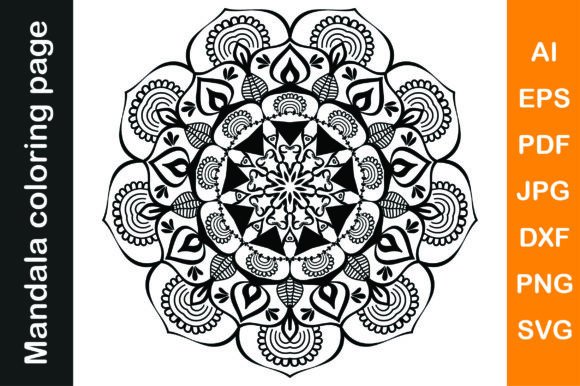
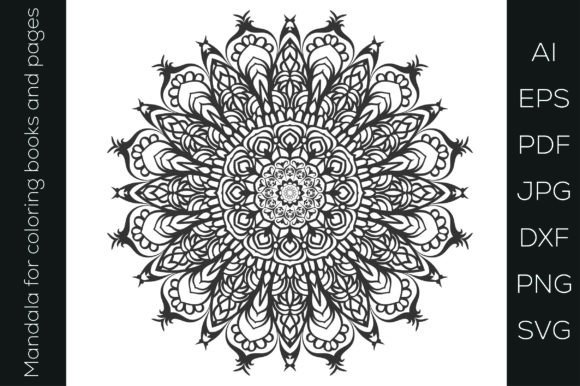
The first thing that struck me was the balance of the composition. The mandala sits with a confident symmetry that does not feel stiff. There is a gentle rhythm in the petal layers, a back-and-forth between dense inner rings and slightly more open outer sections that gives the eye room to breathe. That matters more than you might expect when you are converting a flat graphic into a stitched product. Overly cramped lines become muddy in thread. This one has breathing room.
What I Saw the Moment I Opened the File
The source files came clean and organized, which is never something I take for granted. An AI file, an EPS, an SVG, and a DX file. That is a thoughtful set of formats for anyone who works across different software, and I appreciated not having to chase down a missing vector the way I have had to do with other purchases. The SVG opened smoothly in my digitizing software, and the paths were well-structured. No jagged nodes, no weird overlapping artifacts. That alone saved me about twenty minutes of cleanup work.
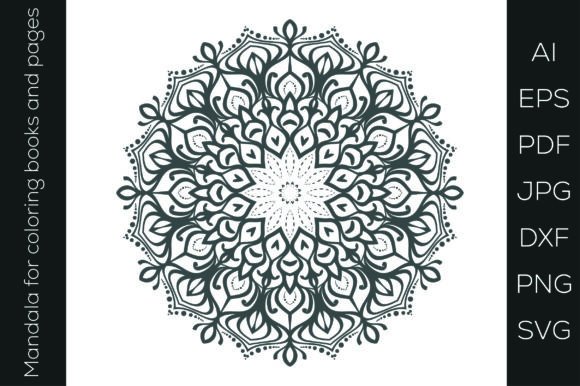
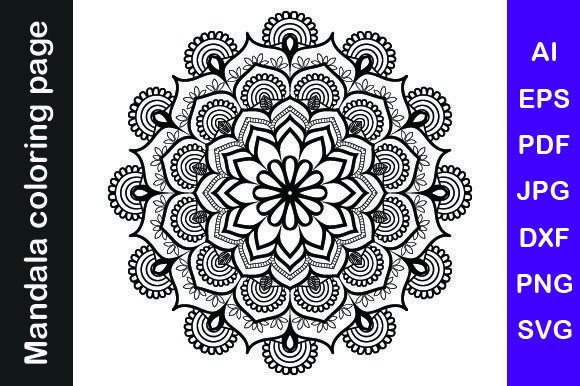
The design itself has a classic mandala personality. Concentric rings, floral petal motifs, delicate inner detailing, and a border that feels complete without being heavy. It is not overly intricate to the point of being punishing, and it is not so simple that it looks like a beginner trace. There is a middle ground here that I find genuinely useful. It reads as thoughtful, meditative, and slightly ornate without tipping into fussy.
I immediately pictured this on a natural linen pillow cover. Something about the combination of the structured geometry and the softness of the fabric felt right. That is the kind of instinct I trust after years of testing, and it is worth mentioning because not every design sparks a clear product vision that quickly.
The Real Test: How It Behaves in an Embroidery Workflow
Here is where I need to be direct. Mandala Coloring Pages Vol. 10 is sold as a graphics product for coloring books and pages. That is its primary category, and that is how it is described. If you are an embroidery designer, you are going to need to convert it yourself. The source files are vector-based, which means the hard part of tracing is already done for you, but you still need proper digitizing work to turn those clean paths into a stitch-ready embroidery file.
I ran a test conversion on a section of the design using my usual digitizing settings, and I was pleased with how the paths translated. The smooth curves stayed smooth. The petal tips did not collapse into awkward angles. I did reduce some of the finest inner details by about ten percent because at the scale I was testing, those tiny flourishes would have been smaller than a single needle width. That is not a flaw in the design. It is just the reality of thread physics. You adjust, you test, and you learn what your machine can handle.
I tested the converted design on a medium-weight cotton canvas at a five-inch hoop size, and the result was clean. The satin stitch borders held their shape. The fill stitch areas laid down evenly with a medium density. I used a cutaway stabilizer, which I would recommend for any mandala design because the stitch count will be dense enough that you want the extra support. On a tearaway, the fabric puckered slightly at the outer edges. Nothing catastrophic, but noticeable enough that I would not skip the cutaway on a client piece.
A Real Project Scenario: The Custom Tote Bag
I had a friend ask me recently to make something for her sister's birthday. She wanted something that felt personal but not overly sentimental, something that could be used every day without looking like a novelty gift. I showed her three mandala options, and she picked the one I had converted from Mandala Coloring Pages Vol. 10 without hesitation.
I stitched it onto a natural canvas tote bag in a warm terracotta thread. The design took about forty minutes to stitch out at a six-inch diameter, and the result was exactly what I had hoped for. The mandala shape gave the bag an elevated, boutique feel. It looked like something you would find in a small shop for a lot more than the materials cost me. My friend cried when she saw it, and her sister apparently uses the bag every day.
That is the kind of real-world outcome that makes me trust a design. It is not about how it looks on a screen. It is about the moment someone holds the finished product in their hands and feels like it was made just for them. This design delivered that moment.
Where It Shines Brightest
Through my testing, I found several product categories where Mandala Coloring Pages Vol. 10 performs exceptionally well. Tote bags and canvas pouches are at the top of the list. The structured surface shows off the detail without fighting the thread. Pillow covers and cushion fronts are another natural fit. I can see this working beautifully on a linen or cotton-linen blend, especially in a single rich thread color like mustard, deep teal, or rust.
For apparel, I would recommend placing this design on the back of a denim jacket or the center chest of a relaxed-fit sweatshirt. The mandala shape sits well on flat, stable surfaces. It also works nicely as a decorative accent on aprons, kitchen towels, and fabric napkins for someone who wants to elevate their handmade home goods line.
For Etsy sellers and small shop owners, this design offers a lot of versatility. You could stitch it in classic white on a dark background for a crisp, modern look. You could go tone-on-tone for a subtle texture that catches the light. You could use variegated thread for a more artistic, painterly effect. The underlying structure is strong enough to support creative interpretation, which is not always true of mandala graphics that rely too heavily on color gradients to create depth.
Where You Need to Be Careful
I want to be honest about the limitations I observed. The design has a lot of dense inner detail, and at hoop sizes below four inches, some of that detail will start to blur together. I tested a three-inch version on a baby onesie, and while the overall shape was still recognizable, the innermost rings lost their crispness. For small items like baby clothes or narrow hat fronts, I would recommend simplifying the center section or scaling up slightly.
Stretchy fabrics are another area where caution is warranted. I tested the design on a cotton-spandex blend, and even with a fusible stabilizer, there was a slight distortion at the edges where the fabric pulled during stitching. It was not a disaster, but it was not the crisp result I would want for a paying customer. On woven fabrics, the design behaved beautifully. On knits, I would recommend heavy stabilization and a test stitch before committing to a final product.
Dark fabrics also require some thought. The mandala relies on line clarity and shape definition to read well, and on black or charcoal fabric, you need a thread color with enough contrast to pop. I tested a navy-on-black combination, and the design receded too much. A bright white, metallic gold, or vibrant coral thread solved the problem instantly. The design itself is not the issue. The color choice on dark backgrounds is just something to plan for.
Practical Notes for the Working Designer
Before you list a finished product using this design in your shop, there are a few things I recommend doing. First, check the licensing terms that came with your purchase. Since this is a graphics product in the Coloring Pages Amp category, the commercial use permissions may differ from what you expect with an embroidery-specific file. Do not assume. Verify. That five-minute check can save you a headache later.
Second, test the design on scrap fabric that matches your final product. I know that sounds obvious, but I have met too many makers who skip this step and then wonder why their customer's sweatshirt looks different from their test canvas. Different fabrics absorb thread differently. Different stabilizers change the finish. Test it exactly as you plan to sell it.
Third, review the stitch density after conversion. The vector paths in Mandala Coloring Pages Vol. 10 are clean, but the density settings your digitizing software applies can vary. If the design feels too stiff or too sparse, adjust before you run a full stitch-out. The underlying artwork is good, but the digitizing is where the real embroidery magic happens.
I also recommend testing the design in a black-and-white mockup to see how it reads without color. This is a trick I use for every design I plan to offer in multiple thread options. If the shape still holds up in monochrome, it will work in almost any color combination. This one passed that test with ease.
The Bottom Line From My Stitching Table
Mandala Coloring Pages Vol. 10 is a well-crafted vector graphic that translates thoughtfully into embroidery work when you put in the proper digitizing effort. It is not a plug-and-play embroidery file, and it does not claim to be. What it offers is a solid, clean, versatile foundation that an experienced maker can build on with confidence.
I have used it on tote bags, tested it on pillows, and seen it make someone genuinely emotional about a birthday gift. For a design that started as a coloring book asset, that is a pretty impressive range. It will not solve every embroidery challenge, and it needs a thoughtful hand on the digitizing side, but the core artwork is strong, the files are clean, and the creative possibilities are genuinely wide open.
If you are a maker who enjoys the process of converting and customizing, this is a purchase worth considering. If you are looking for a ready-to-stitch embroidery file, you will need to budget time for the conversion step. Either way, the design itself is a pleasure to work with, and the finished products I have made with it have consistently drawn compliments, repeat requests, and happy customers. That is the measure that matters most to me.